Core drills for Angle grinder
2 models


Sort:
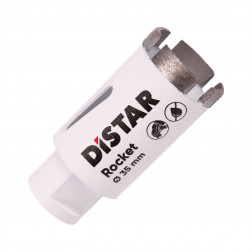
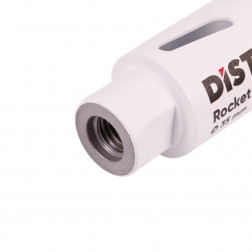
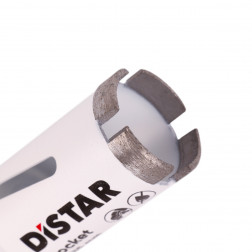
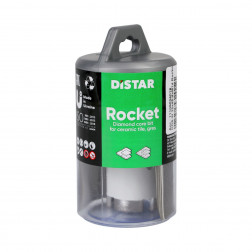
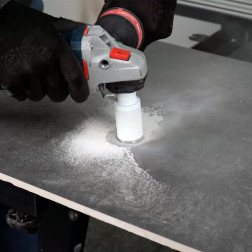
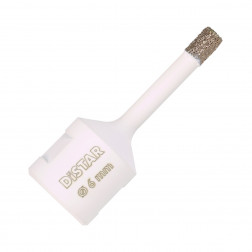
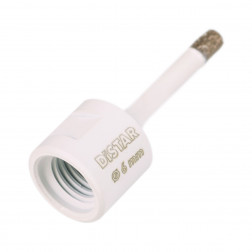
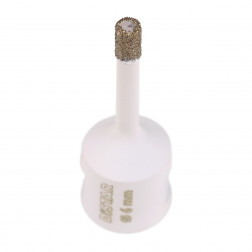
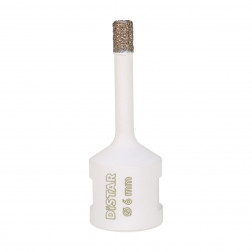
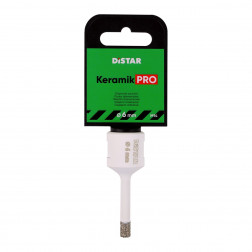
Various types of renovation work in interiors made of ceramic tiles or porcelain stoneware require drilling holes in the tile. Currently, the most popular tool for performing such tasks is the diamond hole saw. Drilling with diamond hole saws can be carried out using several types of equipment:
- Drill
- Screwdriver
- Hammer drill
- Angle grinders
Drilling with angle grinders is performed in dry mode, while on other types of equipment it is almost always done with coolant supply. Thanks to the dry drilling function, hole saws for angle grinders are becoming increasingly popular among professionals. In addition to working in dry mode, hole saws for angle grinders are characterized by high processing speed even for the hardest tiles. Let’s take a closer look at tile hole saws for angle grinders, their types and application specifics.
Types of hole saws for angle grinders
Depending on the production method, diamond hole saws for tiles are divided into vacuum brazed, sintered, and electroplated. Hole saws made using vacuum brazing technology operate only with coolant supply, which is why this type of drill is produced only for drills, hammer drills, and screwdrivers. Let’s take a closer look at vacuum brazed and sintered diamond hole saws for angle grinders and their main differences.
Vacuum brazed hole saws for angle grinders
Vacuum brazing technology involves fixing synthetic diamonds onto the drill body using a thin layer of metal in a vacuum environment. Thanks to this technology, only one layer of diamonds is formed on the drill, and when they wear out or fall off, the material processing speed gradually decreases until the cutting ability is completely lost. This means that vacuum drills have a relatively low service life.
In vacuum diamond hole saws for angle grinders, large-grit diamonds are used, which is why they leave noticeable chips on the processed surface. They are most often used for drilling technical holes that will be hidden. Thanks to the large diamond size, high processing speed is achieved. Vacuum drills are the best hole saws for porcelain stoneware for angle grinders, since porcelain stoneware is a very hard material and is best processed with large diamonds.
Sintered hole saws for angle grinders
Powder sintering technology involves mixing powders of various metals (copper, silver, tin, nickel, etc.) together with synthetic diamond into separate segments, which can be welded or soldered to the body of the hole saw for angle grinders. Since dry processing of tiles leads to an increase in temperature in the drilling zone, diamond segments are most often welded to the body, as this fastening method is more resistant to high temperatures. The height of diamond segments can range from 8 to 10 mm, and almost all of this height is working. When 0.5–1 mm of the segment height is worn off, new diamonds emerge from the metal bond, allowing work to continue without loss of performance. Thanks to this design, hole saws for angle grinders have a very high service life.
Another clear advantage of such hole saws is the ability to use both large and small grit diamonds, which allows drilling holes with fewer chips.
Tips for using hole saws for angle grinders
On the one hand, drilling tiles may seem like a fairly simple process until you encounter it in practice. There are many nuances and pitfalls that are better to know in advance.
- Drill the tile only from the front side, since chips at the exit will be larger than at the entry point.
- If you are drilling a tile that is not installed on a wall, place a soft base under it (drywall, foam, etc.).
- When drilling an installed tile, try to stop the process immediately after passing through the tile.
- For initial drilling, it is better to use special templates so that the hole saw for the angle grinder does not slip and damage the front surface of the tile.
- At the first contact with the material, hold the drill not straight, but at an angle of 45–40 degrees to create a small groove.
- After the groove appears, gradually straighten the drill until it starts working with the entire surface.
- Always try to tilt the drill in different directions, this improves diamond performance and helps remove dust from the hole.
- To remove dust during cutting, you can use special dust extraction devices.
- If you need a non-standard hole (or a hole larger than your drill), you can use special finger bits to enlarge holes.
- If vacuum hole saws for angle grinders start to spark heavily or melt the tile — they should be replaced, as the diamond cutting edges are no longer sufficient for normal operation.
- If your sintered drill starts to spark and melt the material — you can sharpen it by drilling several holes in an abrasive material (silicate brick, fresh concrete, ceramic tile, etc.).
These simple tips will help you complete your work as quickly and correctly as possible.
Where to buy hole saws for angle grinders?
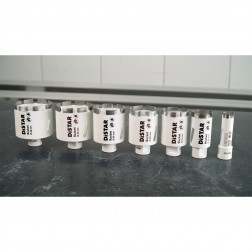
A wide range of hole saws for angle grinders for ceramic tiles and porcelain stoneware is available on the DIstar website. Here you will find hole saws with diameters from 6 to 120 mm, which allows you to perform the full range of tile drilling tasks. On this site you can:
- Select diamond hole saws for your equipment
- View prices for different types and diameters of hole saws
- Buy and order delivery to any city
- Read recommendations for using specific drills
- Watch training videos on working with diamond tools
And this is not the full range of advantages and convenience of purchasing hole saws for angle grinders via the DIstar website. By choosing Distar diamond tools, you choose quality and excellent service!
FAQ
What materials can be processed using diamond hole saws for angle grinders?
Hole saws for angle grinders are excellent for processing tiles, ceramic tiles, and hard porcelain stoneware. Synthetic diamond is a very hard mineral, which makes it easy to process even thick, hard porcelain stoneware. It should also be remembered that all manufacturers of diamond hole saws specify which material a particular drill is intended for. To achieve high quality work and good service life of the hole saw, follow the manufacturer’s recommendations and process the material for which the tool is designed.
How to avoid overheating of a diamond hole saw during operation?
To minimize heating of the hole saw, you should constantly change the angle of contact between the drill and the material. Such oscillating movements improve dust removal from the cutting zone and act as an additional cooling factor for the tool. You should also avoid drilling many holes in a row; take breaks between holes so that the drill can cool down.
What are the main types of hole saws for angle grinders?
For angle grinders, vacuum brazed hole saws are most commonly used, however, more and more tool manufacturers are starting to develop sintered hole saws for angle grinders. This is due to the fact that many professionals are not satisfied with the relatively low service life of vacuum drills.